

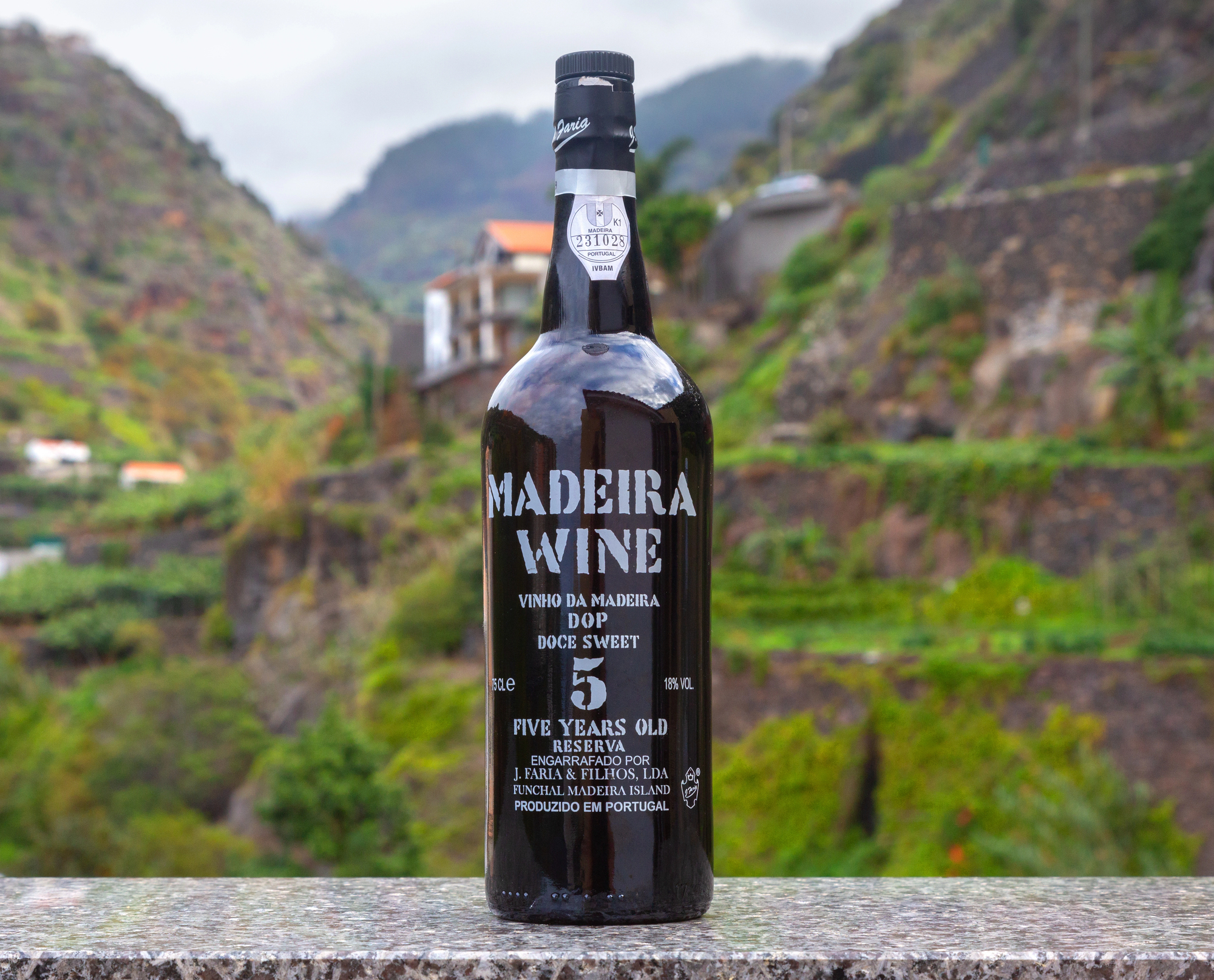

Vinho da Madeira DOP — Doce Sweet 5 Years Old Reserva
J. Faria & Filhos, Funchal, Ilha da Madeira
The Island Born of Fire That Learned to Make Wine
To understand a bottle of Madeira you must begin with geography, because here terroir is not a sommelier’s concept — it is a volcanic and oceanic fact that explains everything.
The history of Madeira dates back to 1418, when navigators led by João Gonçalves Zarco sighted, after many days adrift on the open sea, a small island that saved them from a fateful end. They named it Porto Santo — safe harbour — and a year later, in 1419, they found to the southwest a dense, wild, green mass which they baptised Madeira for the abundance of timber that covered it. It was a floating paradise in the middle of the Atlantic.
The volcanic soil, the subtropical climate and the influence of the trade winds created perfect conditions for the cultivation of the vine. The first settlers, many of them from mainland Portugal, brought with them grape varieties that soon found a fertile new home in Madeira. During the fifteenth century, Madeira became an important port of call on the trade routes between Europe, Africa and the Americas.
And this is where the happiest accident in the history of wine took place.
The ships crossing the Atlantic would take on supplies in Funchal and carry local wine in their holds. To preserve it during the long voyages, brandy or spirits were added, and it was discovered by chance that the heat and the motion of the sea transformed its flavour, making it more intense and longer-lasting. The fortified wine of Madeira had been born.
When sailors noticed that the wine had acquired a peculiar and agreeable taste, this happy accident led producers to begin developing techniques to intentionally subject the wine to high temperatures. The process involved storing the wine in oak barrels and exposing them to the heat of the sun as the ships crossed the tropics. A caramelised paradise, born of movement, heat and ocean.
Fame arrived quickly, and it travelled far. In the eighteenth century, Madeira wine became enormously popular in the American colonies. Figures such as George Washington and Thomas Jefferson were passionate admirers of Madeira. It was the wine chosen to toast the signing of the Declaration of Independence in 1776 and Washington’s presidential inauguration in 1789. This was no ordinary wine — it was the wine of founding moments.
The first exports to England took place in 1537, with great expansion across continental Europe and the New World following during the eighteenth century. Yet the nineteenth century would bring catastrophe: between 1852 and 1897, plagues of phylloxera and powdery mildew ravaged the vineyards, destroying 90% of all plantings. From that devastation was born, paradoxically, the great protagonist of modern Madeira: Tinta Negra Mole, a red variety that resisted, adapted to every climate and soil on the island, and today produces the vast majority of wines under the denomination.
The Technical Marvel: Estufagem and Canteiro
Madeira is the only wine in the world deliberately subjected to heat as part of its production process. It is, in a sense, a wine that has been cooked. And that, far from being a flaw, is its greatness.
The estufagem consists of heating the wines in estufas at temperatures between 45 and 50°C, a process that achieves in three months what five years of sun exposure would otherwise accomplish. This method is used for younger, more commercial non-varietal wines.
Its older and more aristocratic sibling is the canteiro: young wines begin their ageing in the upper parts of the lodge, where heat is greatest, before gradually descending to lower levels where maturation develops more slowly. The barrels used are mostly American oak, and always well-seasoned, so as not to impart aromas to the wine.
The result of both processes is a wine with a quality that makes it unique in the world of wine: its high alcohol content allows it to travel well on sea voyages and to age extraordinarily. Bottles can last a century or more in the cellar. A wine that is, quite literally, immortal.
The Varieties: A Map of Flavour
Madeira wines have traditionally been made from the white grape varieties Sercial, Verdelho, Boal and Malvasia, formerly known as the noble varieties. Sercial is typically used for dry wines, Verdelho for medium-dry, Boal for medium-sweet and Malvasia for the sweetest styles.
After phylloxera, the great change in the island’s vineyards was the rising dominance of Tinta Negra. This variety adapts perfectly to sandy soils and achieves better yields than the white varieties, while possessing great versatility to produce wines of different sweetness levels. The vast majority of wines made today come from this grape.
J. Faria & Filhos: The Lodge That Lets Its Wines Speak
J. Faria was established more than 60 years ago and is a small family company that maintains a discreet profile, allowing its wines to speak for themselves. And they do so with eloquence.
The island of Madeira has a total area of 732 km² and the wine-growing region extends across some 500 hectares. It is a unique landscape, characterised by steep, dramatic terrain. The particular conditions of the volcanic, mostly basaltic soil, combined with the proximity to the sea and a climate of hot, humid summers and mild winters, give the wines their singular character.
J. Faria is dedicated to the production of Madeira wines, fruit liqueurs and sugar-cane distillates. A company that needs no great fanfare, because it has something better: the patience of those who know that time, in Madeira, always works in their favour.
Technical Sheet
| Appellation | Vinho da Madeira DOP |
| Producer | J. Faria & Filhos, Lda. — Funchal, Madeira |
| Style | Doce / Sweet |
| Category | 5 Years Old Reserva |
| Main grape | Tinta Negra Mole |
| Process | Estufagem (controlled heating) + wood ageing |
| Minimum ageing | 5 years |
| Alcohol | 18–19% vol. |
| Residual sugar | Above 78 g/l (sweet style) |
| Service | Slightly chilled, 12–14°C — no decanting required |
The Tasting
The Eye — Amber of a Cathedral
The colour of this Madeira asks no permission: it simply imposes itself. It is an intense golden amber, warm, with coppery glints that call to mind melted caramel or the interior of a candlelit church. There is none of the youthful transparency of a white wine: it carries the colour of something that has passed through fire and emerged transformed, darker and wiser.
It is noticeably deeper than other styles in the same range, with a depth of colour that anticipates the intensity of what is to come. The tear is dense, oily, almost glycerol-like; it slides slowly down the glass like warm honey. This wine is in no hurry. It has spent five years learning to move this way.
The Nose — The Pantry of a Portuguese Grandmother
Bring the glass close and do nothing. Wait. The first olfactory gesture of this Madeira is a warm, sweet and smoky rush: toasted caramel, Corinth raisins, figs dried in the sun. It is a generous nose, without pretension, that keeps no secrets for a second encounter.
The aromas reveal tones of oak, raisins and honey, with notes of earth and wood woven through the background. There is also a hint of toasted nuts — hazelnut, lightly scorched almond — which is the unmistakable imprint of the estufagem process, that deliberate heating that caramelises the sugars and transforms the wine into something no other region in the world knows how to make.
The profile offers notes of dried fruit, caramel and a warmth of nuts, balanced by a subtle sweetness that lingers. With time in the glass — and this wine is patient — a note of candied orange peel also appears, a citrus wink that cuts through the sweetness and gives it tension. And in the background, very far back, almost a whisper: vanilla, nutmeg, a hint of tropical wood.
It is an honest, direct nose, with no pretensions to grandeur but with a very strong identity. It smells, unmistakably, of Madeira.
The Palate — Sweet, With a Backbone
The entry on the palate is sweet, yes, but not cloying. And this is what distinguishes a good Madeira from any possible imitation: the great freshness, the strong acidity and the great complexity, with a broad bouquet of aromas from the ageing — dried fruits, hazelnuts, figs, raisins, vanilla, orange peel, chocolate, honey — make these wines complex, rich, intense and of enormous longevity.
It is the acidity that commands here. It is lively, almost vibrant, and it is acidity that saves the wine from becoming a syrup: it acts as a backbone, a spine holding all the sweetness in place without letting it collapse. On the palate we find caramel, prune, dates, toasted almonds and that note of milk chocolate that appears in well-made sweet Madeiras.
The palate is pleasant, smooth and juicy, with good acidity and a caramelised finish. Rather good. The finish is long, warm and persistent. The sweetness does not leave abruptly but fades in gentle waves, leaving a trail of candied fruit and a faint salinity — that mineral signature of the volcanic soil — which invites another sip.
These wines made from Tinta Negra offer a refreshing and smooth experience when served slightly chilled. It is advice worth heeding: a gentle chill opens the wine, sharpens the acidity and turns something already good into something memorable.
Food Pairing — Knowing Whom to Share It With
This 5-year-old sweet Madeira is a wine of thresholds: it works at several moments and with several companions at table.
As an aperitif, slightly chilled, it surprises and pleasantly unsettles: its acidity makes it livelier than its sweetness would suggest. With foie gras, liver pâtés or blue cheeses — a Roquefort, a Gorgonzola — the pairing is classic and perfect: sweet against salty, unctuousness against acidity.
With desserts: nut tarts, almond sponge cakes, crème caramel, bolo de mel — the traditional Madeira cake made with spices and molasses — or medium-intensity dark chocolate. It also works, quite surprisingly, with sweet and sour sauces on game meats or duck.
And also, why not, on its own. With a free afternoon and no particular hurry.
Overall Assessment Doce Sweet 5 Years Old
| Aspect | Score |
|---|---|
| Appearance | ★★★★☆ |
| Nose | ★★★★☆ |
| Palate | ★★★★☆ |
| Value for money | ★★★★★ |
| Overall | 87–89 / 100 |
The Wine That Knows No Oblivion
Madeira is perhaps the most misunderstood wine in the world. Associated with cooking recipes, with grandmother’s kitchen or with that dusty bottle at the back of the cupboard, it has carried for decades the stigma of the old-fashioned. And yet those who truly discover it — who give it a clean glass, the right temperature and a moment of genuine attention — find something radically different: a wine with character, with history and with an acidity that no other sweet wine in the world can match.
This J. Faria & Filhos Doce Sweet 5 Years Old is not the most complex Madeira in the world, nor does it claim to be. It is a young, accessible, honest and well-made Madeira; a perfect gateway into one of Europe’s great winemaking traditions.
Behind this bottle lie six centuries of history bound to the oceans, to navigators, to kings and to the founding moments of entire nations. There are vineyards on impossible clifftops above the Atlantic, black lava soils, lodges that smell of time.
Serve it chilled. Close your eyes. And listen to what a volcanic island in the middle of the ocean has to tell you.
“Madeira is not a wine to be drunk. It is a wine to be remembered.”
J. Faria & Filhos Doce Sweet 5 Years Old

Sobrelías Redacción
Sobrelías Redacción