


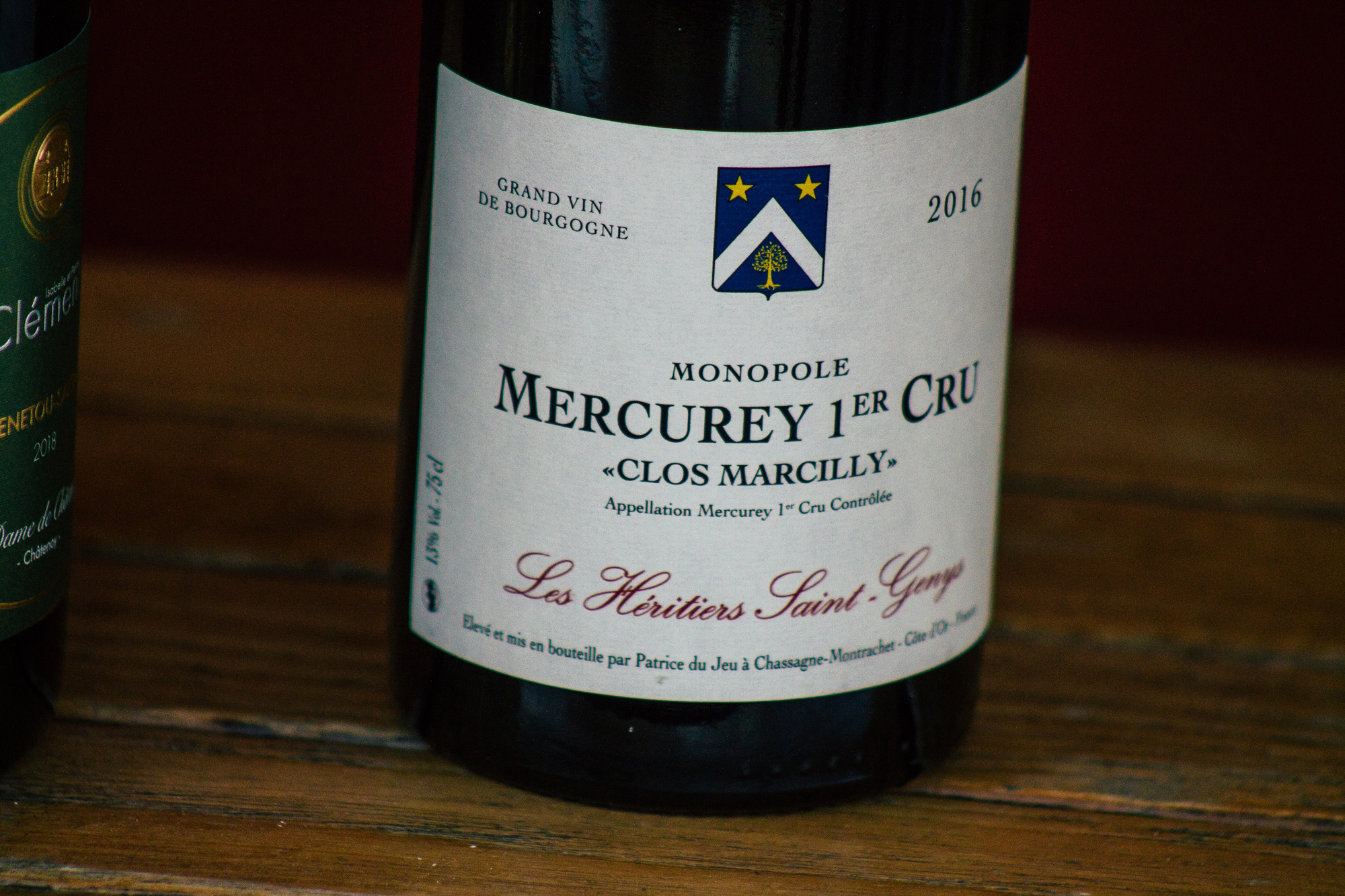
Mercurey 1er Cru Clos Marcilly Monopole 2016 Les Héritiers Saint-Genys
by Patrice du Jeu
The God of Commerce and His Vineyards
To understand this wine you must go back, quite literally, to the Romans.
It was the Romans who, upon erecting a temple dedicated to Mercury, gave the village its name and introduced the vine to Mercurey. Traces of viticulture in Mercurey and the Chalonnais have been found dating back to Antiquity. The god of commerce and travellers presided from the very beginning over a terroir that, twenty centuries later, continues to produce wines that travel well and deserve to be traded with pride.
Mercurey, situated at the heart of the Côte Chalonnaise, 12 kilometres from Chalon-sur-Saône, is one of the great appellations of Burgundy. Sheltered from damp winds, the vineyards spread across the slopes of what is known as the Val d’Or — the Golden Valley — as far as the neighbouring village of Saint-Martin-sous-Montaigu. The vines grow at altitudes of between 230 and 320 metres on soils of Oxfordian marl and limestone.
Today, Mercurey encompasses some 650 hectares of vineyard, with 32 climats classified as Premier Cru accounting for 25% of the appellation’s surface area. It is the most extensive appellation of the Côte Chalonnaise, the most prolific, and in many respects the most ambitious. The red wines of Mercurey are the deepest in colour and flavour of the entire Côte Chalonnaise, with greater intensity and concentration, and the finest ageing potential in the region.
Clos Marcilly: A Parcel With Memory
Among those 32 premiers crus, one deserves a chapter of its own. Its ancient name says almost everything.
The word Marcilly is thought to derive from the Gaulish march and the late Latin terms mariscus and mariscelleus, meaning “marshland, boggy places.” A damp, earthy name that evokes the land as it was before the vine transformed it. For Clos Marcilly is no ordinary premier cru: it was one of the first five premiers crus to receive official recognition in 1943, making it one of the most original and venerated climats in the entire appellation.
Clos Marcilly is a Premier Cru parcel in the western part of the Mercurey appellation, within the sub-region of the Côte Chalonnaise. It is one of the five original Premier Cru vineyards named in 1943 and, despite its somewhat secluded position, it maintains an excellent reputation for both its Pinot Noir and its Chardonnay. The walled vineyard covers some 7.5 hectares and lies on a gentle southeast-facing slope, just north of the hamlet of Etroyes.
The walls that surround it are no decorative accident. They are armour: the parcel, completely enclosed by stone, is thus shielded from the most severe frosts. The presence of a natural spring means it does not suffer unduly during periods of drought. Nature, here, was generous with the details.
And yet, at the turn of the twenty-first century, this privileged vineyard languished in abandonment. The walled enclosure had fallen into neglect in the early 2000s. By 2011, no grapes were being grown there at all. A Premier Cru with eighty years of institutional recognition, emptied of life, sleeping within its own walls.
Patrice du Jeu: The Restaurateur Who Became a Vigneron
Les Héritiers Saint-Genys embodies the singular journey of Patrice du Jeu, a former restaurateur who became a winegrower out of passion and conviction. In 2010, he took over an abandoned 12-hectare domaine between the Côte de Beaune and the Côte Chalonnaise, which he entirely restructured with rigour and humility.
He was a man who knew how to serve wine before he knew how to make it. Who was familiar with the side from which the cork is drawn before he knew the side on which the harvest is gathered. And perhaps for that very reason — through the eyes of one who had watched people drink, be moved, remember — he decided it was worth giving back its life to a corner of Burgundian earth that time had forgotten.
The domaine embarked on an ambitious programme of parcel restoration, to return to its climats the prestige they had once known. Based in the heart of the village of Chassagne-Montrachet, the domaine Les Héritiers Saint-Genys tends just over 12 hectares of vines spread between the Côte Chalonnaise and the Côte de Beaune.
In 2011, Patrice du Jeu acquired Clos Marcilly in Mercurey. From 2017, animal traction was reintroduced for soil work, and the winery was renovated to benefit from the finest vinification techniques. Work in the vineyard follows a reasoned approach: mechanical soil cultivation, cover cropping, the use of horses in the oldest parcels, and not a single herbicide.
The result of that decade of silent and meticulous work is what you now have in your glass.
The 2016 Vintage: The Harvest of Miracles
The year 2016 in Burgundy was one that tested the faith of winegrowers. It was a vintage that began as a tragedy and ended as a story of redemption.
The 2016 vintage in Burgundy stands as a testament to the resilience and spirit of the region’s vineyards and vignerons. Confronted with serious climatic adversity — spring frosts, hail and mildew — the vintage was marked by significantly reduced yields. Despite the lower volumes of production, the 2016 vintage was acclaimed for its quality potential: the red wines of that year stand out for their depth and complexity, and the reduction in yields contributed to a concentration of flavours that promises to evolve magnificently over time.
And while the Côte d’Or was mourning its losses, the Côte Chalonnaise came as a surprise. The reds of the Côte Chalonnaise — from Mercurey, Givry and Rully — offer excellent value in 2016, a vintage that shows vibrant fruit expression. In the Côte Chalonnaise, the 2016 reds are agreeably ripe.
As Jérôme Flous, winemaker at Domaine Faiveley, recalled: “The Côte Chalonnaise has benefited greatly from climate change. There used to be several vintages per decade with green flavours and marked acidity, but today that is no longer a problem.” And James Suckling himself declared: “The 2016 vintage has such a strong identity that if you want a lesson in Burgundy with strong typicity, try the 2016s.”
The 2016 is a fresh, taut, vertical vintage. A vintage that speaks of place before it speaks of sunshine.
Technical Sheet
| Appellation | Mercurey 1er Cru AOC — Côte Chalonnaise, Burgundy |
| Climat | Clos Marcilly — Monopole |
| Producer | Les Héritiers Saint-Genys |
| Bottler | Patrice du Jeu, Chassagne-Montrachet |
| Vintage | 2016 |
| Grape | Pinot Noir 100% |
| Soil | Clay-limestone, Jurassic limestone, at 230 m altitude |
| Average vine age | ~60 years |
| Ageing | Well-seasoned French oak barrels, Burgundian tradition |
| Alcohol | ~13% vol. |
| Service | 16–17°C, decanted 30–45 minutes |
| Drinking window | Drink now through 2030–2033 |
The Tasting
The Eye — Burgundian Winter Ruby
In the glass, this Mercurey presents itself with that deep, crystalline ruby which is the unmistakable hallmark of a great Pinot Noir. It is not the opaque red of brute power, but the translucent ruby of refinement: a colour that allows light to pass through as though the wine had nothing to hide. The reds of Mercurey are typically of deep and pronounced ruby colour.
The rim is slightly violet, a sign of relative youth: at nine years in bottle, this wine has not yet reached the brick of maturity. It is at that precious moment of early adulthood, when the fruit still lives and complexity is already beginning to show. The tear is fine, elegant, with good glycerol but without ostentation. It is the discreet weeping of a wine that knows exactly who it is.
The Nose — The Forest After a September Rain
Bring the glass close. Without swirling. The first gesture of this Marcilly is a rush of fresh red fruit: tart cherry, wild raspberry, a trace of blueberry. It is the clean, direct fruit of the Côte Chalonnaise Pinot Noir in a cool vintage like 2016 — fruit that has not been cooked by an excessive summer, fruit that recalls what is freshly picked in the vineyard.
The nose offers morello cherries with subtle earthy, undergrowth nuances that lead into an exceptional Mercurey. Stay there. Now the damp woodland floor emerges, that humus of Burgundian earth which is the seal of the clay-limestone terroir of Clos Marcilly. There is also a touch of violet, delicate and fleeting, like the perfume of a flower glimpsed from a distance. And very far back, barely hinted at, a whisper of sweet spices — clove, pink pepper — announcing that beneath all that elegance there is structure.
Notes of wood, a touch of bourbon vanilla, coffee, brioche and buttery notes, with a hint of almond milk and a mineral thread. The nose is complex but not loud. It speaks quietly, with the confidence of one who has no need to raise their voice to be heard.
The Palate — Tension and Silk
The entry on the palate is the revelation of this wine. The attack is broad and precise, sustained by a beautiful mineral tension that balances the richness of the matter. The texture is silky; the wine stretches out with elegance.
The tannins are the most interesting story of this Premier Cru. The palate has a wonderfully silky texture, despite the impressive tannic structure, with a long, refined finish that leaves a pronounced note of liquorice. They are fine, well-mannered tannins that do not astringue but envelop; that do not halt but prolong. It is the touch of Pinot Noir when the vine has decades of life and the winegrower knows how to respect what the earth gives.
The acidity — a direct inheritance of the 2016 vintage — is present and lively, like an underground current lending freshness and length to everything. Brilliant, balanced acidity is a clear characteristic that underlines the appeal of both the whites and the reds of this vintage. It is that acidity which transforms the fruit from mere pleasure into true wine.
The mid-palate offers ripe cherry, redcurrant, a touch of cocoa, spices from a wooden box. The finish leaves a persistent sensation of freshness and purity. The aftertaste is long and mineral, with that saline, calcareous note that is the signature of the Clos Marcilly soil.
It is a wine of balance before power. Of precision before abundance. A Burgundian Pinot Noir, in the purest and most demanding sense of that expression.
Overall Assessment
| Aspect | Score |
|---|---|
| Appearance | ★★★★☆ |
| Nose | ★★★★½ |
| Palate | ★★★★½ |
| Terroir expression | ★★★★★ |
| Value for money | ★★★★★ |
| Overall | 92–94 / 100 |
Closing Reflection — The Monopoly of the Authentic
There are wines that speak of brand. There are wines that speak of vintage. And there are wines that speak of place. This Clos Marcilly Monopole 2016 belongs to the third category: it is, above all, a wine that speaks of a 7.5-hectare parcel, enclosed between stone walls, in the Hameau d’Etroyes, with Jurassic limestone soils and vines that have spent decades learning to read that earth.
To own and work a monopole is a responsibility of the highest order, and is considered a privilege. It is comparable to what Romanée Conti has made famous with its own monopoles such as Romanée Conti and La Tâche. Patrice du Jeu, that Parisian restaurateur who one day traded his dining-room apron for vineyard boots, took that privilege with all the seriousness it deserves.
A Premier Cru of breeding and harmony, a faithful reflection of its Clos and its monopole, combining finesse, depth and serenity. Serenity is perhaps the most fitting word for this wine: it is not a wine that seeks to impress. It is a wine that seeks to persuade. And it does so with that particular stillness of things well made.
In 2026, at nine years in bottle, it is at an excellent moment. It can be drunk now with full satisfaction, or kept until 2030–2033 to watch as the minerality and the fruit merge into something still more unified and profound.
«Un grand Bourgogne n’élève pas la voix. Il attend qu’on lui tende l’oreille.»
“A great Burgundy does not raise its voice. It waits for you to lend it your ear.”
by Mercurey 1er Cru Clos Marcilly Monopole 2016 Les Héritiers Saint-Genys

Sobrelías Redacción
Sobrelías Redacción