


Quinta do Tedo: The Douro in the First Person
Arriving at Quinta do Tedo feels like stepping into one of those Douro postcards that seem designed to explain why this region has turned wine into a cultural landscape. Among steep slopes, terraced vineyards and the calm flow of the river, the winery offers more than a visit: it invites an immersion into the identity of Portuguese Port.
The estate combines the beauty of its setting with a very clear vision of wine tourism: to show the origin of the wine from vineyard to glass. Here, every sip seems to carry precise coordinates. The Douro is not just a backdrop; it is the key to understanding everything that happens at the winery.
A Landscape of Height and Stone
The first impression is visual and almost physical. The Douro commands attention through its terrain, through the way the vines cling to extreme slopes, and through that sense of human labour embedded in the geography. Quinta do Tedo draws on this environmental force to build an experience that blends landscape, history and tasting.
In this context, Port wine ceases to be an abstract category and becomes a concrete expression of climate, soil and tradition. The visit helps explain why this area produces such diverse wines, with profiles ranging from the aromatic freshness of rosé to the depth of vintage.
The Tasting: Four Ways to Read the Douro
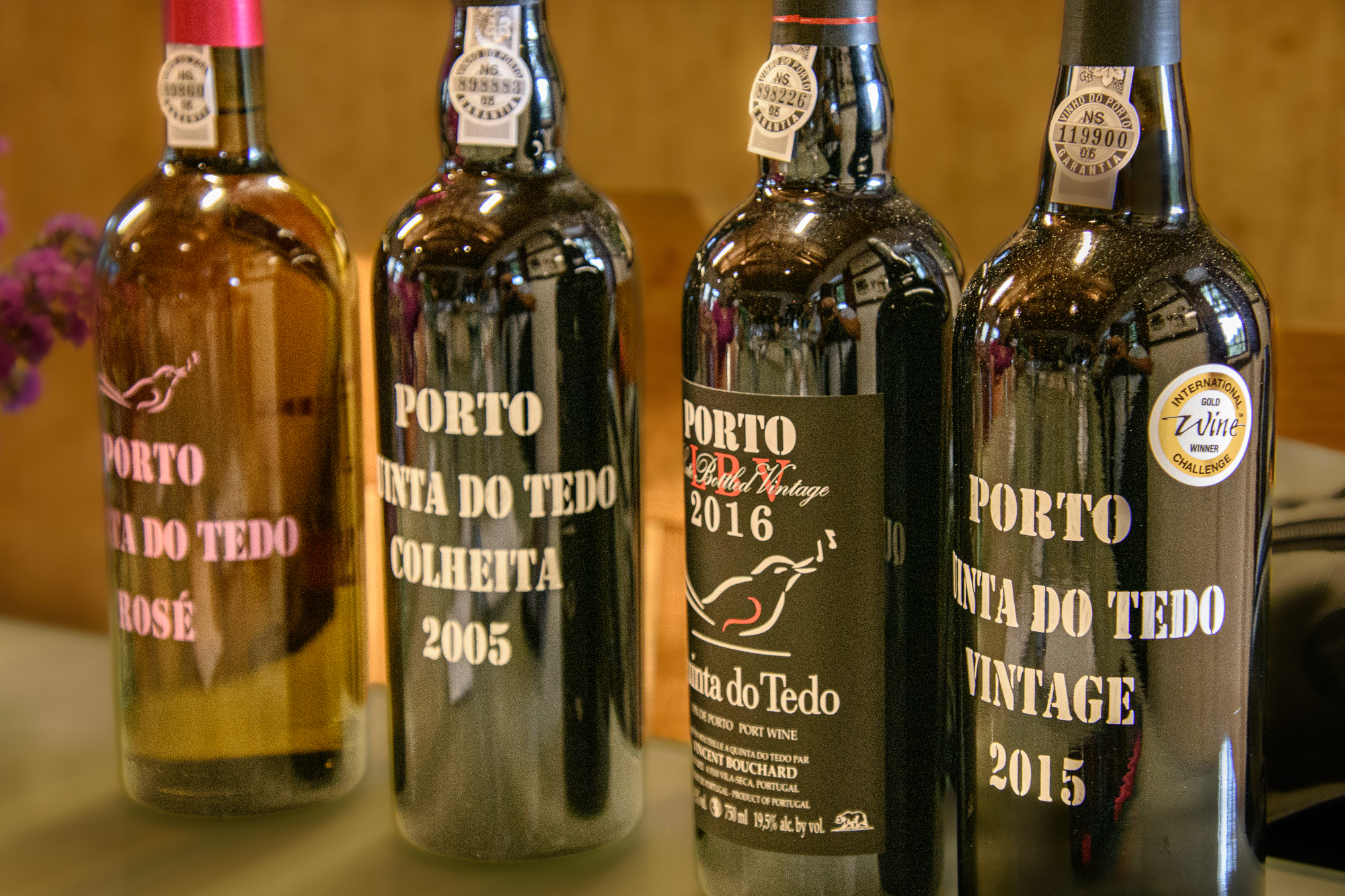
The tasting at Quinta do Tedo can be understood as a small journey through different ages and sensibilities of Port. Each wine reveals a facet of the same territory, as if the Douro changed its voice depending on ageing time and winemaking style.
Porto Quinta do Tedo Rosé
The rosé opens the experience in a lighter, more modern register. It is the approachable entry wine, the one that shows a fresher and more accessible face of the Port universe. It typically offers red fruit, a vibrant profile and a more playful, almost aperitif-like character, without losing its connection to the house’s identity.
In this type of tasting, the rosé acts as a gateway. Its role is to demonstrate that Port can also speak softly, in a fresher, more contemporary language.
Porto Quinta do Tedo Colheita 2005
The Colheita 2005 introduces time as the main protagonist. Here, oak, controlled oxidation and bottle evolution shape a wine of greater complexity, with notes of dried fruits, caramel, spices and a more enveloping texture.
It is a wine that demands slow attention, as its charm lies in its depth. Colheita is often an especially elegant way of showing how patience transforms the character of a Port into something smoother, more nuanced and more contemplative.
Porto LBV 2016
The LBV 2016 provides a very interesting midpoint between youth and maturity. The Late Bottled Vintage style retains more fruit-driven energy than a Colheita, while offering more structure and seriousness than an entry-level wine.
In the glass, it typically shows black fruit, volume and a firm tannic backbone that makes it highly gastronomic. It is the wine that most clearly expresses the power of the Douro without sacrificing accessibility. In this sequence, it acts as a bridge between initial freshness and the solemnity of vintage.
Porto Quinta do Tedo Vintage 2015
The closing with the Vintage 2015 lifts the tasting to its most expressive level. Vintage is the most concentrated and ambitious form of Port, and here it appears in full intensity: deep black fruit, richness, structure and a sense of grandeur that calls for time to fully unfold.
It is a wine of great architecture, with an energy that combines density and verticality. If the rosé charms, the Colheita seduces through memory, the LBV balances, and the Vintage impresses. In a visit like this, the final wine makes it clear that the Douro not only produces beauty, but also wines capable of lasting and evolving over time.
Meaningful Wine Tourism
What makes Quinta do Tedo particularly interesting is that the visit goes beyond simply showing facilities. The experience connects the place with what is in the glass in a very direct way. The visitor understands that Port is not an isolated product, but the natural result of a singular territory and a precise tradition.
This is probably the greatest value of wine tourism in the Douro: allowing the landscape to explain the wine, and the wine, in turn, to reveal the landscape. Quinta do Tedo fulfils this role well by offering a clear, welcoming and sensory interpretation of the region.
Leaving Quinta do Tedo after tasting four such different Ports is like leaving with a complete lesson on the Douro. The rosé brings freshness and modernity; the Colheita 2005, memory and complexity; the LBV 2016, structure and balance; and the Vintage 2015, concentration and grandeur.
Taken together, the winery offers a visit that is remembered not only for what is seen, but for how much better one understands the wine after tasting it at its origin. And that, ultimately, is the best definition of a great wine tourism experience: a place where the landscape becomes flavour, and flavour, in turn, restores the full dimension of the landscape.

Sobrelías Redacción
Sobrelías Redacción