


[dropcap]T[/dropcap]he “vending” debate in wine is one worth opening. After analysing different opinions from both consumers and producers, the balance suggests that wine vending machines have a real value proposition, but one that is highly dependent on context. Where volume, location and customer profile align well, the model works solidly. Where any one of those three factors fails, the drawbacks tend to outweigh the advantages.
In favour
Availability 24/7 One of the most obvious advantages is the ability to operate without interruption. In environments such as hotels, airports, spas or tourist areas, demand for wine does not stop when staff finish their shift. A machine can serve a glass at 2 in the morning in a hotel lobby without needing to keep a member of staff on duty. This not only extends the revenue window, but improves the customer experience at moments when conventional service is impractical or very costly.
Reduction in labour costs In low- to medium-volume businesses, keeping a sommelier or waiter dedicated exclusively to wine service may not be profitable. A machine amortised over three or four years can operate for decades with minimal maintenance costs. This is particularly attractive for wineries with their own shop, rural hotels or restaurants that want to offer an extensive wine list without the qualified staff that would normally be required to manage it.
Serving by the glass without wasting the bottle This is perhaps the strongest argument from a business perspective. Opening a premium bottle of wine to serve only one or two glasses carries a risk of product deterioration and financial loss. Modern inert gas systems — argon or nitrogen — preserve opened wine for weeks without any relevant loss of organoleptic qualities. This makes it possible to offer by the glass labels that would otherwise only be available by the bottle, broadening access to high-end wines and increasing the average spend per serving.
Temperature control and dosage precision Unlike human service, where serving temperature and the amount per glass can vary, a well-calibrated machine guarantees absolute consistency. Reds at 16–18 °C, whites at 8–10 °C, sparkling wines at 6–8 °C. Every glass served with exactly the specified number of millilitres. For certain contexts — technical tastings, designed pairings, cost control in hospitality — this precision has real and measurable value.
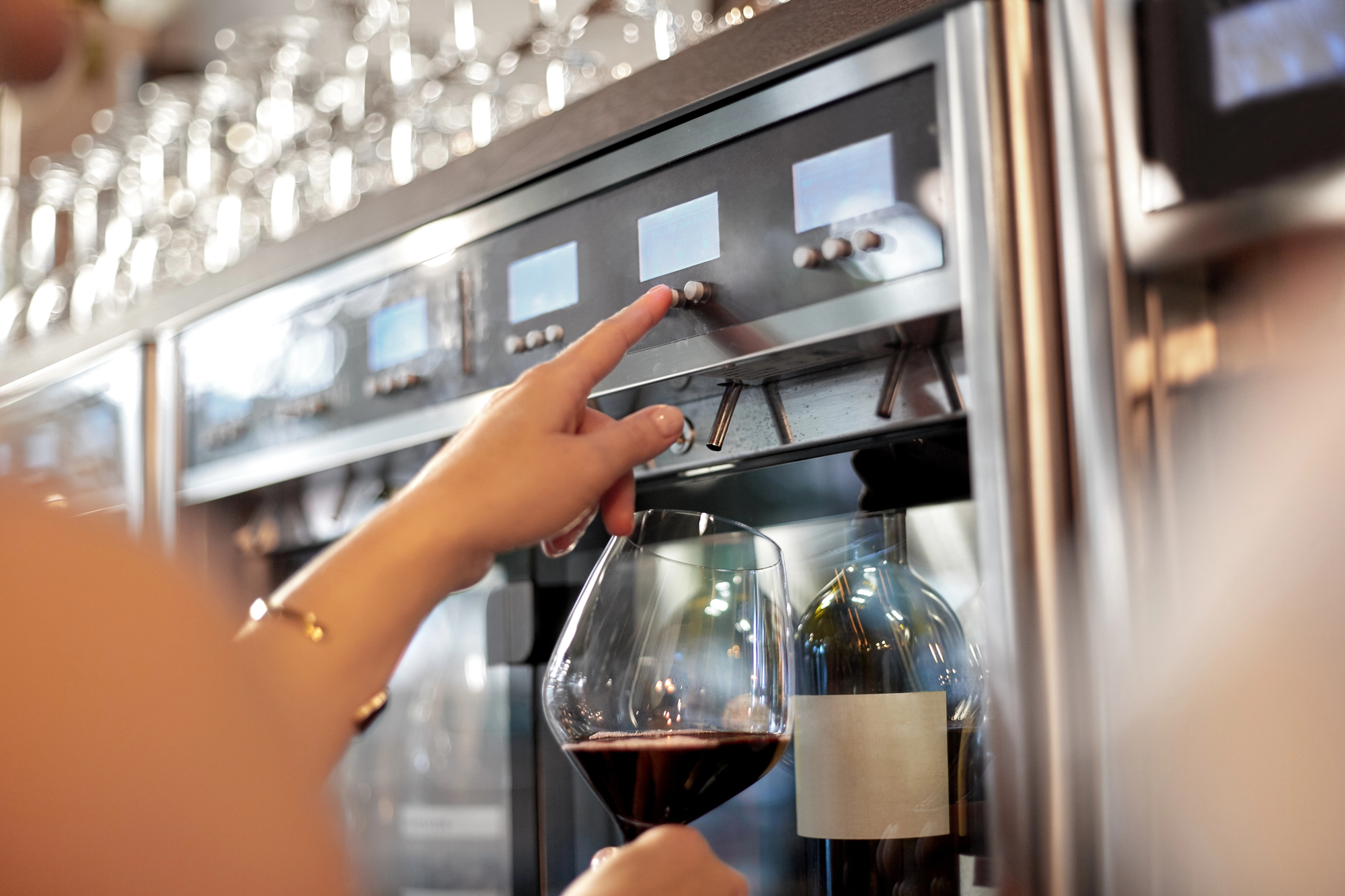
Novelty and appeal as an experience In the wine tourism segment, the machine ceases to be a substitute for service and becomes an attraction in its own right. A winery that offers a wall of wines with an automatic dispenser, technical fact sheets on screen and the ability to taste small quantities of several labels creates an interactive experience that many visitors photograph and share. This user-generated content effect has a marketing value that is difficult to quantify but very real.
An expanding market with proven cases This is no longer a hypothesis: profitable, established installations exist in Italy, the United Kingdom, the United States and France. The global market for specialised beverage vending machines is growing steadily, and manufacturers have invested in solving the technical problems that previously limited the format — preservation, temperature, user interface — which considerably reduces the technological risk for anyone adopting the model today.
Against
Wine culture is inseparable from the human experience Wine is one of the consumer products with the greatest cultural, ritual and social weight. The sommelier’s recommendation, the conversation about the vintage, the suggested pairing with a dish, the story of the winery told with passion: all of this forms part of the perceived value of the product, especially at the mid-to-high end. A machine can serve the liquid with technical precision, but it cannot read the customer, suggest a label that fits their mood or create the emotional bond that turns a glass into a memory. In quality restaurants, removing that human element is equivalent to degrading the product.
Complex and fragmented regulatory barriers As we have seen in the Spanish case, regulation on the automatic sale of alcohol is restrictive and varies by region. Obtaining the necessary authorisations, installing certified age-verification systems and ensuring the machine operates under direct supervision at all times adds a considerable layer of legal and bureaucratic complexity. In many markets, the cost of regulatory compliance can erode much of the labour cost saving that justified the initial investment.
The quality perception barrier Vending is culturally associated with low-cost products, quick convenience and poor quality: soft drinks, snacks, cheap coffee. Applying that same interface — coins, a touchscreen, a product dropping into a tray — to a 30-euro bottle of Ribera del Duero creates a cognitive dissonance in many consumers. Even if the machine is technologically sophisticated, the first impression can devalue the product in the customer’s mind before they even taste it. Overcoming that prejudice requires a level of design, communication and contextual work that not all operators are willing or equipped to undertake.
Maintenance, hygiene and operational reliability A wine dispenser is not a coffee machine. The pipework, precision valves, inert gas reservoirs and surfaces in contact with the product require rigorous cleaning protocols and frequent servicing. A technical failure in the gas system can ruin the contents of several opened bottles. A refrigeration breakdown over a weekend can mean significant losses. Unlike a standard vending machine, where a fault means losing a few cans, here the affected product can have considerable value.
The problem of low turnover Even with the best preservation systems, an opened wine has a limited shelf life. If the machine offers twelve different labels and daily turnover is low — something common outside high-footfall environments — maintaining product quality becomes a constant challenge. Serving a wine in suboptimal condition not only represents a direct financial loss, but can damage the establishment’s reputation disproportionately, especially if the customer was expecting a premium experience.
High initial investment with uncertain returns Quality specialised wine machines — with zone-by-zone thermal control, inert gas system, advanced user interface and ID reader — range from 10,000 to 40,000 euros per unit. Add to that installation, integration with the establishment’s payment system and staff training to supervise it. The financial break-even point requires a sustained sales volume that is not guaranteed, especially during the first months of operation, when customers are still discovering and building trust in the format.
What is permitted and under what conditions
Alcohol vending machines may only operate inside establishments where consumption is not prohibited, in a location that allows constant supervision. Special authorisation is required and they are subject to specific taxes. They must also include age-verification mechanisms to prevent access by minors.
Age verification: the central problem
Legislation requires machines to include effective technical mechanisms, with direct supervision and custody, guaranteeing that minors cannot purchase alcoholic beverages. In practice, this means an electronic ID reader, a registered card or the presence of an employee are mandatory, not optional.
The regional patchwork
There is no uniform regulation across the national territory: the sale of alcoholic beverages through vending machines may be restricted depending on the region and specific location. Galicia, for example, has its own alcohol prevention legislation that may be more restrictive than the national standard.
A Spanish initiative that attempted the model
The company Vinateando launched the first automatic wine bottle vending machine system in Spain as part of its “Wine Club Experience”, aimed at wineries and hospitality establishments. It is the best-known attempt to adapt the format to the existing legal framework — placing machines inside licensed premises with supervision — although its scale remains very limited.
Conclusion: in Spain, a wine vending machine is legal, but only if it is located inside a licensed hospitality venue, under direct employee supervision and with active age verification. That brings it closer to an interactive display with autonomous payment than to a classic vending machine, which explains why the model has barely taken off here compared to countries such as Italy or the United Kingdom, which operate under more flexible frameworks.
Examples already in practice
There are very specific and successful cases spread across several countries. Here are the most notable:
Vagabond Wines — London is perhaps the most striking example. This urban bar chain has 140 wines available by the glass through Enomatic dispensing machines across its venues. Customers load a prepaid card and explore the selection at their own pace, in quantities of 25 ml for tasting or 125/175 ml for drinking. The concept worked so well that Vagabond grew from a single bar in Fulham to six locations across the city.
Cave O Vin — France is the most recent and producer-oriented venture. This company, based in Aix-en-Provence, installs modular refrigerated lockers — with capacities from 60 to 1,000 bottles — directly in wineries, hotels, supermarkets or roadsides. The winery manages stock in real time through a digital interface; the buyer places their order online and collects by scanning a QR code. Temperature is controlled by wine type: 14 °C for reds, 8–10 °C for whites and sparkling wines.
WineStation (Napa Technology) — USA is the largest-scale case. Its system preserves up to 28 opened bottles for 60 days using argon gas, and is present in more than 30 American airports, as well as hotels, supermarkets and cruise ships. According to data from its competitor Wineemotion, establishments that incorporate these machines see an average increase of 40% in wine sales.
Existing Conditions — New York took a more creative angle. This cocktail bar installed two repurposed 1960s vending machines to dispense bottled cocktails — martinis, Manhattans, highballs — at 15 dollars a bottle. Customers bought a token at the bar, inserted the coin and collected their bottle. The result went viral on Instagram and the bar was selling more than 100 bottles a week through the machines alone.
Moët & Chandon also entered the game with a premium positioning. The maison is rolling out a network of champagne vending machines in the United States, with a unit price of 35,000 dollars.
The common pattern across all successful cases is the same: these are not autonomous machines on the street, but systems integrated within a space that has human supervision or digital identity verification. The key to success lies not in the technology but in the combination of the right context, responsible management and jurisdictional regulatory compliance. The machines that work are supervised extensions of an existing alcohol licence, not autonomous points of sale.
Provisional verdict
Viability depends enormously on context: in high-footfall environments with low human attention (airports, hotels, self-service wineries) the model works. In quality restaurants, the human factor remains a competitive advantage that is difficult to replace. The most likely path to success is a hybrid model where the machine complements — rather than replaces — personal service.
In short, wine vending machines already exist and work in certain contexts — Italy has some of the best-known installations in wineries, and European airports use them successfully — but they still need to overcome three serious obstacles: regulation on the automatic sale of alcohol (which varies by region in Spain), the cultural perception of wine as a product that deserves human attention, and the maintenance cost of a system that preserves the wine correctly.
The most promising niche is precisely that of wineries and wine tourism, where the machine becomes an interactive attraction rather than a substitute for the sommelier.

Sobrelías Redacción
Sobrelías Redacción